

Collaboration is not just about shared creativity; it is about the collision of two distinct data sets to generate a new, unpredictable output. It invites us to step out of our closed loops and enter a "Shared Network," often leading to outcomes that fork and diverge like the avenues of a maze.
Here are three protocols that exemplify the transformative power of this signal integration.
7×7.la Collaboration with Poet Adam Soldofsky
One of my first major system integrations took place with poet Adam Soldofsky for 7×7.la. The platform functioned like a surrealist parlor game—a recursive loop where two creators engage daily to build an improvised narrative.
From the start, Adam and I shared an instinctual frequency. Our work explored a familiar sense of unease and disorientation. The result, Not an Exit, became a reflection of these themes—a narrative maze with no(?) escape. It was a perfect feedback loop of text and image, creating an infinite recursion of memory.
Body Painting Collaboration with Photographer Patrice Delmote
My fascination with labyrinths eventually demanded a living substrate. In Filles d'Ariane, a collaboration with Taiwan-based French photographer Patrice Delmote, I moved from canvas to skin.
I treated the human form as a topography, using eyeliner to map intricate mazes directly onto the model. The maze appeared like a mysterious affliction or a biological circuit board spreading across the surface. This was a high-precision operation—each line required the focus of a tattoo artist.
The resulting images marry the rigid, algorithmic nature of my mazes with the organic, evocative chiaroscuro of Delmote's photography. It was a successful merger of the Geometric and the Organic.


The full project can be purchased HERE.
In the Mood for Art: A COVID-19 Project for Revver Magazine
During the global system failure of 2020 (COVID-19), physical proximity became impossible. The social nexus was severed. However, the signal found a new path.
I was invited by Shanghai-based photographer Stéphane Ferrero to participate in Lockdown for Revver Magazine. This was a "Remote Integration." We combined body painting, photography, and fiction to capture the profound isolation of the era.
The project visualized a "virus" not as a disease, but as a graphic pattern—a complex network of black lines growing on the skin. Since physical contact was impossible, the body painting was applied via post-production—a digital infection layered over real photographs. It was a testament to the resilience of the creative network, even when the physical world was offline.


&LOG ..#317
I noticed it for the first time yesterday, as I went to bed, on my shoulder, a small dark wave. It grew. It looks more like a flowing web this morning, just larger.
------2020^3¨3
&LOG ..#318
I’d never realised how empty it was, my apartment, despite all the junk. Full of stuff, devoid of substance… I think boredom is going to get me, unless that dark stuff does the job faster. Dunno what it is… It grows.
------2020^3¨4
&LOG ..#319
Didn’t do anything yesterday… Carrousel of kinetic junk, and I pay for it every month. Go figure… Ah! I heard my neighbour crying. I don’t like her anyway.
------2020^3¨6
&LOG ..#320
I went to see her this morning. Not that I was concerned… Just annoyed by the whining. She showed it to me. It’s like “mine”: a complex network of lines; noires. It grows.
------2020^3¨7
&LOG ..#321
Couldn’t find anything online about it. It’s like a germ. It grows, and that all it does actually. No pain, no fever, no symptoms. It just grows.
------2020^3¨9
&LOG ..#322
Nothing to do anyway, so I decided to give some substance back to my burrow: dumping away all the rubbles of my “memories”. I found my old film camera in a box. Completely forgot about that stuff. Only 7 frames left.
------2020^3¨11
&LOG ..#323
My neighbour’s name’s Lucy. Dunno why I never cared to ask. She’s bored too. We agreed we’d have fun with the camera. Filling the void… She’s actually pretty. Dunno why I never cared to look.
------2020^3¨12
&LOG ..#324
Still growing, still no pain, no fever. It just grows… We finished the roll.
------2020^3¨13
Sometimes, a system integration operates on a time delay. You input the code, but the execution happens years later, often in a format you never anticipated.
Years ago, I designed the cover art for The Dark Manual by the Japan-based, award-winning writer Colin O’Sullivan. At the time, it was a contained collaboration—a visual interface for a textual story. I could never have calculated that this specific node would eventually expand into a global broadcast.
That book has now been adapted into the Apple TV+ series Sunny. Starring Rashida Jones, the show is a dark, comedic drama set in Kyoto, centering on a woman living with a domestic robot after a mysterious plane crash.
While the show utilizes a new visual interface (needless to say, my original artwork was not retained for the adaptation), the satisfaction lies in the trajectory. In an artistic career, planting seeds is a critical protocol. You initiate processes without knowing their compilation time. To see this specific seed grow into a massive production—revolving around themes of robotics and grief that parallel my own interests—is a thrilling validation of the "long game."

Role: Director, Visual Artist Medium: AI-Generated Video (Midjourney V3 & V4), Animation
Project Overview In collaboration with singer-songwriter Bertille, I directed the music video for "La Fuite," a track from her album Distances. The piece serves as an audio-visual study of Generation Y—a generation paralyzed at the friction point between the analog past and the hyper-digital future.
Concept & Execution The visual narrative explores the dissociation of the "Millennial" experience: being acutely aware of the world yet feeling detached from it. To mirror this paradigm shift, the entire video was constructed using generative AI, specifically leveraging the rapid evolution of Midjourney to demarcate different planes of existence.
We utilized the specific aesthetic limitations of Midjourney V3 to render the "virtual world" where the protagonist’s consciousness is trapped. Its glitchy, pixelated, and often incoherent nature evokes a raw, cyberpunk nostalgia—a sharp contrast to the polished photorealism of Midjourney V4, which was employed to depict the "real world" scenes.
This deliberate clash of resolutions visualizes the tension between our physical reality and the machine-generated streams we increasingly inhabit. Every frame was generated, reworked, and manually animated to stitch together a cohesive narrative from the chaos of the latent space.
A private project with Bastien Siebman from IDO, who is not only a long-time Asana expert but also my cousin.
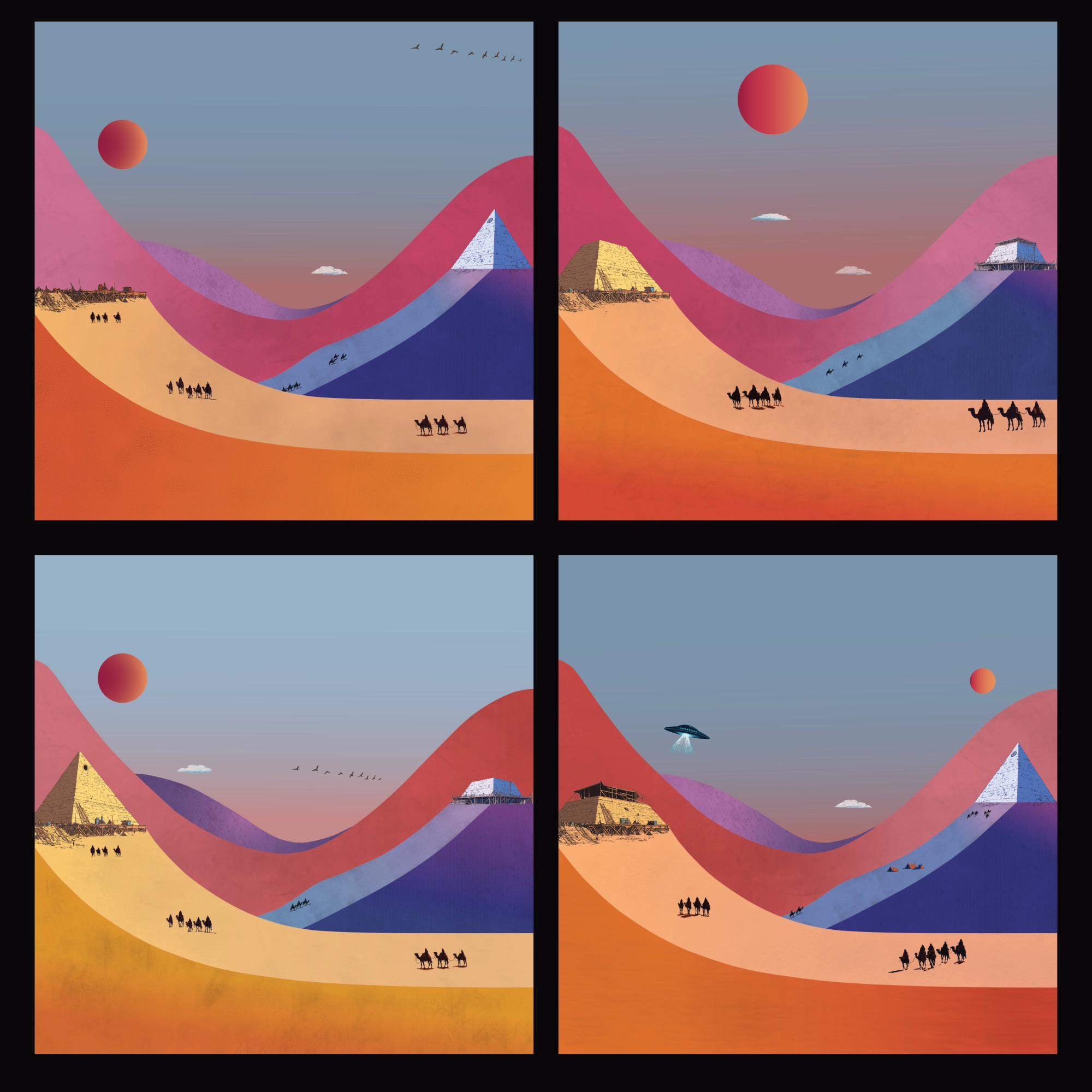
A recent conversation sparked a truly unexpected collaboration. We created a generative artwork based on task IDs from an Asana workspace. Each piece begins with the first task where a specific person was mentioned, and from that task’s 16-digit unique ID, we derive a completely original visual composition.
Each digit (0–9) maps to a version of a specific layer—sky, birds, dunes, clouds, nomads… With 16 layers and 10 variations per layer, there are 10¹⁶ possible combinations.That’s ten quadrillion potential artworks!!
And yet, each one tells a story that feels personal and deeply symbolic to the person who receives it—printed on canvas and linked to the task ID of a project they may have spent countless hours working on.
This isn’t Kura Curiosa. The aesthetic is entirely different—colorful, direct, almost comic-book style. But at its core, it’s still about modularity, identity, and building meaning from structured fragments.
Another way of exploring how systems and stories emerge from code, chance, and collaboration.
Huge thanks to Bastien for making this journey happen.
The Nakagin Capsule Tower is gone. The Gunkan Building in Higashi Shinjuku might soon follow. Kikutake’s Hotel Sofitel Tokyo, another striking relic of the Metabolist era, was demolished in 2016. These icons of the Metabolist movement—once symbols of an adaptive, modular future—are now little more than memories, dismantled in favor of generic urban renewal.
Metabolism imagined cities as living, evolving organisms—an architecture designed to expand, transform, and adapt. But reality had other plans. Prefabrication dreams gave way to maintenance nightmares, and a movement that once embodied Japan’s technological optimism now lingers only in old photographs, archived blueprints, and scattered fragments of concrete and steel.
For me, Metabolist architecture was never just about buildings. It was about a philosophy—of modularity, of impermanence, of structures that could evolve rather than stagnate. These ideas have shaped much of my own artistic approach, from my Derelict/Black series to the evolving modularity of Kura Curiosa.
Recently, I had the chance to collaborate with US artist Jason Lujan on a project that revisits the Nakagin Capsule Tower through a different lens. Using Holga analog photographs I had taken of Nakagin before its demolition, Jason reinterpreted them into a new artwork. As he put it:
"This artwork captures the essence of that philosophy under entirely new circumstances—its once-playful design now frozen in a state of obsolescence. This piece reflects themes of instability, urban abandonment, and the inevitable shift from innovation to deterioration."
This piece was presented last month in Toronto at MKG127 Gallery, standing as a visual eulogy to a future that never quite arrived.
It seems that many people mourn the loss of an architectural dream? Can Metabolism’s vision still inspire something new?