
// Technical documentation and operational data for Open Chambres, The Tape Matrix, and associated open-source protocols.
A: These are interconnected projects bridging digital data and physical artifacts through 3D printing. Open Chambres are an archive of printable specimens in their containment unit. The Tape Matrix is a modular containment system for analog sonic relics. Both are designed to be downloaded, fabricated, and integrated into your own space.
A: V-XL (Baptiste Tavernier), a Tokyo-based creative technologist, artist and curator. He combines 3D printing, speculative narrative, and open-source design to create systems that invite public into an art participation project.
A: Open Chambers, the Tape Matrix and all their modules can be found on Printables.com
Other projects will likely appear in the future, but in any case they will always be listed here.
All those projects are licensed under the Open Community License (OCL)
A: Tape Matrix is a modular system crafted for the seamless assembly of 3D-printed cassette shelves. Naturally, a 3D printer is essential. The system revolves around two key elements: the cassette frames, which serve as the foundation, and the various forms of auxiliary modules that give a cool & futuristic vibe to the whole assembly.
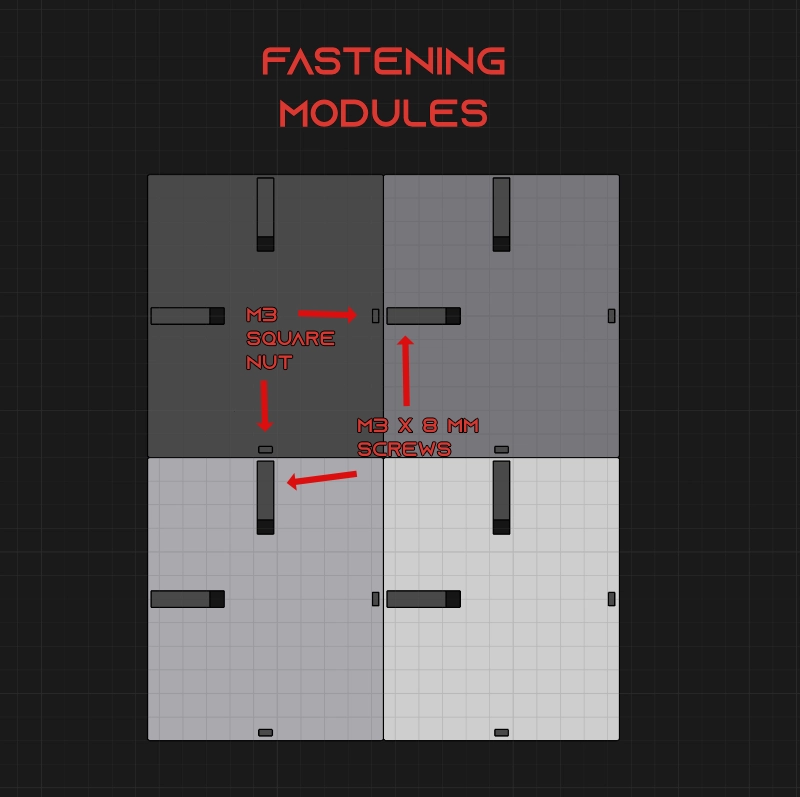
To build your Tape Matrix wall, you’ll need just two simple components: M3 x 8mm screws and M3 square nuts (5.5mm width, 2.5mm thickness). These are all it takes to securely fasten the pieces together and start assembling your own unique modular containment for your sonic relics.
For those looking to display their big collection on walls, the system includes modules with holes that can be used to screw directly the entire assembly onto a wall.
A: All you need is to download a few tape container modules, and if you want to give your collection a sci-fi mood, a couple auxiliary modules. You can always expand your collection by adding new modules to either side of your existing one—the only limit is the size of your wall! New free modules are added from time to time, continually expanding the possibilities and offering endless combinations. There are no rules—build and expand your collection in whatever way inspires you.
Modules can be found here: https://www.printables.com/@baptistetavernier/collections/1789605
A: All projects are designed to be printable on a Prusa MK4 or any printer with an equivalent build volume of 250x210x220mm or higher, which is the case of most consumer 3D printers nowadays.
Most of the collection can in fact be printed on smaller models, like the Prusa MINI, a printer with a build volume of 180x180x180mm. Right now, only a very small number of modules cannot be printed on a Prusa MINI.
A: If you are new to 3D printing, or not very experienced yet, PLA is the best choice. Above the beginner level, it is all up to you. I generally use PETG, so I haven't tried with more exotic materials, such as ASA, Nylon, PC Blend, Chocolate, Ceramic... But it should work, I guess.
A: No particular recommendations... That would depend on the printer and the material you have. Personally, I use:
- a 0.4 nozzle
- Layer height: 0.20mm for most modules, 0.15mm if you want finer details
- Infill: 15%
Adding a brim can be a good idea to avoid warpping.
If you want to use a larger nozzle, I guess it is possible, but you might want to check the tolerance of the attachment system.
A: Well, that would depend on your printer, and the type of material you use. On a Prusa Core ONE, I print a single module in about 3-4 hours.
A: Most projects like the Tape Matrix and Open Chambres are available on Printables.com .
A: Files are provided in STL format. Some files are also available in 3MF if you want to use a multicolor printer.
A: All those projects are licensed under the Open Community License (OCL)
A: New content is released rather irregularly :-)
A: You can always contact me if you are interested in buying exclusive artworks for your collection. Alternatively, exclusive sets can sometimes be seen in galleries or art fairs around the world.